Gradually, and Then Suddenly: The Decline and Fall of ODNI
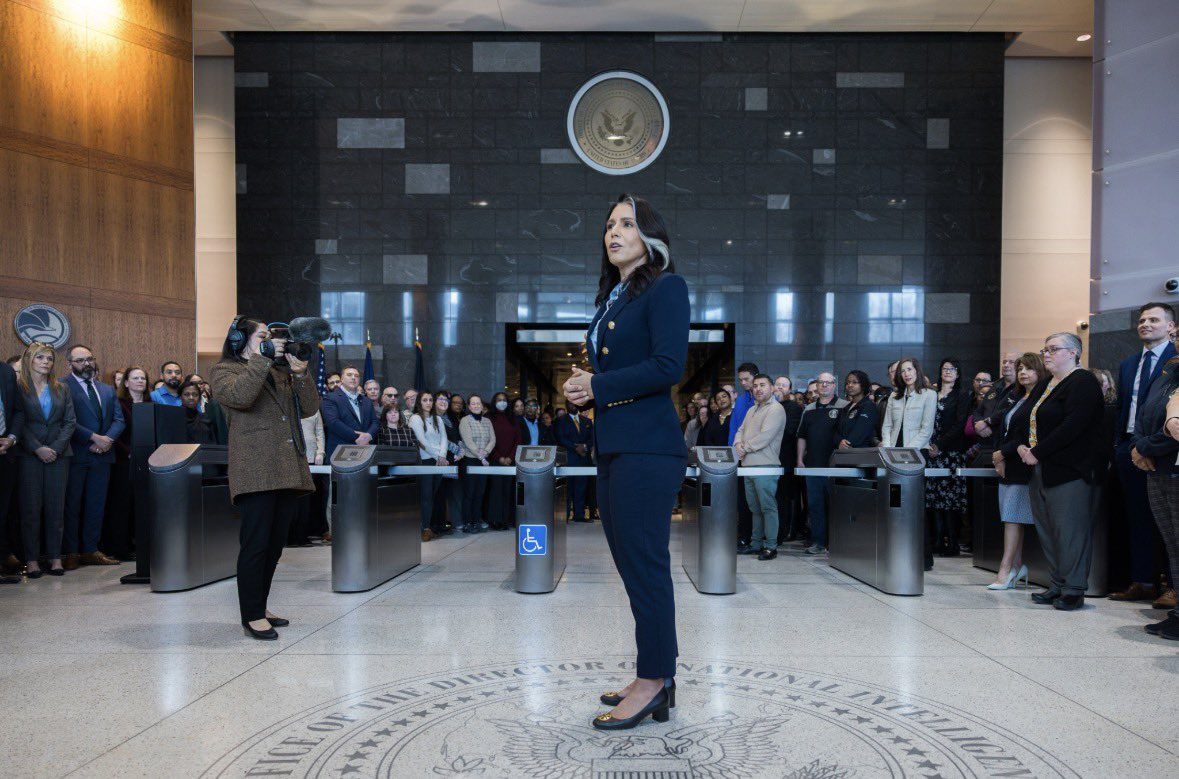


The intelligence community has had a trying few weeks. On June 21, the Washington Post reported that Tulsi Gabbard, the most recent director of national intelligence (DNI), might have been taking political marching orders throughout her entire career from someone often described as a cult leader. A few days after this story broke, the paper provided the receipts and highlighted specific incidents where her speeches and commentary seemed to be based on memoranda provided to her by mysterious third parties.
Prior to the publication of the Post’s stories, Gabbard had already resigned from the Office of the Director of National Intelligence (ODNI), for familial reasons, and President Trump, via a Truth Social posting, named Bill Pulte to act in her stead. Pulte, an individual with zero experience in any and all fields related to the ODNI’s responsibilities, most recently served as the director of the Federal Housing Finance Agency. In that capacity, he became most known for finding supposed mortgage fraud in innocuous loan documents, much the same way Don Quixote could see a lumbering giant in a harmless windmill. This tendency to extrapolate and publicize conspiracies without foundations, in a steadier era, might disqualify someone from a role requiring the rigorous analysis of facts, particularly when the nation’s ability to project force upon the world stage, navigate international relations, and formulate the nation’s domestic security policies are at stake. The reaction across the political spectrum, including from elements of the president’s own party, was unusually frank. Senate Majority Leader John Thune (R-S.D.) said the country does “not need a weaponized” DNI. Sen. Mark Warner (D-Va.), the vice chair of the intelligence committee, said Pulte was picked because the White House believes he will “provide the narrative it wants, not the intelligence we need”, while Sen. Chuck Schumer (D-N.Y.) called Pulte a “partisan thug” with no experience in intelligence.

One can debate whether the current state of the U.S. intelligence community most resembles a tragedy or a farce, but history is certainly repeating itself. The abuses and missteps of the FBI and CIA in the first decades of the Cold War led to a spate of hearings and reforms in the 1970s, which substantially limited the operational latitude of both agencies. A little under 30 years later, in the aftermath of the 9/11 attacks, much ink was spilled arguing that the earlier reforms might have been too constricting, and another massive reform liberalized intelligence authorities and added a coordinating department at the top of the community in the form of the Office of the Director of National Intelligence. But now, two decades hence, the ODNI appears to be acting in a manner similar to the FBI and CIA’s modus operandi before the very first round of reforms.
For anyone acquainted with the workings of the intelligence community, as well as a familiarity with the stakes of its decisions, the ODNI’s limited effectiveness is not surprising, and the political constraints hamstringing its influence are, in many ways, the fault of its prior directors. But it still maintains access to an astounding amount of both raw and finished intelligence, and its statutory authorities are vague enough that it can still chip away at the concept of an apolitical national security state.
The ODNI in Theory
The bill that created the director of national intelligence as a Cabinet official, and the ODNI as that position’s home agency—the Intelligence Reform and Terrorism Prevention Act of 2004 (IRTPA)—was born of tragedy and debacle.
The 9/11 attacks put the intelligence community under a microscope. In 2004, a bipartisan commission published its findings on the component agencies’ cultures, practices, and actions in the years leading up to the destruction of the World Trade Center and parts of the Pentagon. The conclusions were scathing. The National Commission on Terrorist Attacks Upon the United States, also known as the 9/11 Commission, maintained in its final report that the intelligence community lacked both the will and necessary architecture to function as a cohesive whole. The commission particularly excoriated the FBI and CIA on this front, and the criticism led to the report’s most emphatic recommendation:
The current position of Director of Central Intelligence should be replaced by a National Intelligence Director with two main areas of responsibility: (1) to oversee national intelligence centers on specific subjects of interest across the U.S. government and (2) to manage the national intelligence program and oversee the agencies that contribute to it.
…
The National Intelligence Director would retain the present [Director of Central Intelligence’s] role as the principal intelligence adviser to the president.
The private fiefdoms created by Allen Dulles and J. Edgar Hoover would now, in light of a new century’s national security challenges, have no choice but to huddle together under the aegis of a new official and office. Sen. Susan Collins (R-Maine), one of the authors of IRTPA, explicitly cited this conclusion when she reminisced, 20 years later, that “[t]he 9/11 Commission’s report did much more than present a devastating indictment of intelligence failures. It also gave us strong, urgent recommendations for reform.” In her telling, a direct line connects the tragedies in New York City, Washington, D.C., and a field in Pennsylvania with an attempt to restructure the intelligence community in an attempt to guarantee that no other major terrorist attack could occur on U.S. soil. Hers is a tidy narrative, but it’s also woefully incomplete.
In the febrile environment immediately following the 9/11 attacks, it was all but inevitable that al-Qaeda’s murderous actions up and down the eastern seaboard would have foreign policy ramifications, and few expressed surprise or significant opposition when military operations began against the group and their hosts in Afghanistan. The subsequent war in Iraq, though, required more justification to the American public of this second conflict’s necessity, and so the Bush administration seized upon the arguments that its adversary was covertly stockpiling weapons of mass destruction. But within a year of invading Iraq, it became apparent that this supposed cache did not exist, and President George W. Bush established via executive order the Commission on the Intelligence Capabilities of the United States Regarding Weapons of Mass Destruction. This group’s remit was to examine how the intelligence community—still largely unchanged, at least in an architectural sense, since 2001—evaluated and analyzed Iraq’s weapons program in the run-up to the war.
Although the commission’s report would not be complete until after IRTPA’s passage, a litany of the ODNI’s first leaders later averred that its work (in the same publication as did Sen. Collins in 2024)—carried out partially during the bill’s creation—influenced the nation’s creation of the office: “Although 9/11 and Iraq WMD were very different types of intelligence errors, the combination of these events had a snowball effect on the political momentum, leading to large-scale intelligence reform.” One of the Senate Select Committee on Intelligence staffers who worked on drafting IRTPA would emphasize, some 17 years later, just how correct this assertion was:
The IRTPA was also a result of the disastrous consequences of the IC’s errors assessing Iraq’s WMD program. To many, it seemed as if the IC had fallen prey to the politicization of intelligence—the most damning accusation to level at the analytic community—to hew to the view that Saddam Hussein was harboring an active WMD program. IRTPA’s codification of standards for analytic integrity and creation of an IC analytic ombudsperson were designed to address these issues.
With the IRTPA in force by the end of 2004, the ODNI had its marching orders: Coordinate the nation’s sprawling intelligence enterprise, and enforce analytic rigor across the community. The office would not particularly succeed at either.
The ODNI in Practice
Following a declination of the role by Robert Gates—who would shortly thereafter become secretary of defense—President Bush named, and the Senate confirmed, John Negroponte as the first DNI. It was a canny choice. A career foreign service officer and former deputy national security adviser, he had worked closely—and not without substantial criticism—with the CIA on anti-communist operations in Central America. Most importantly, he was known to be a remarkably skilled bureaucratic infighter—a skill much needed if his office was going to coordinate among 17 distinct agencies with their own interests and intrigues. He was assisted in his efforts by his deputy, Michael Hayden, a retired four star Air Force general and former director of the National Security Agency (NSA). Negroponte’s tenure was largely successful, even according to the assessments of some who had been opposed to his office’s creation.
Unfortunately, not all of the nation’s subsequent DNIs possessed Negroponte’s political acumen and instincts. Within five years, DNI Dennis Blair would make a number of unforced errors that diminished the prestige of the ODNI. These missteps drained most of the political capital Negroponte (and his immediate successor, Michael McConnell) had built up for the department’s benefit. The most public of these failures was an ill-conceived decision to go to battle over whether the DNI or the director of central intelligence (DCI) should have the final say over the nation’s principal intelligence officials abroad, a role traditionally filled by the CIA’s chiefs of station. Blair’s predecessors had shared this ambition, but all realized that it was a fight they would probably lose, and that such a loss early in the ODNI’s lifetime would bear serious reputational costs. That Blair chose this conflict, at a time when the DCI was a former political operative with decades of experience within the ruling political party, and was personally close with both the vice president and president, seemed especially obtuse. The ODNI had attempted to spar with the most powerful component agency in its ecosystem, and came out bloodied; everyone noticed, and it was difficult to view the DNI—were any real interagency conflicts to arise—as someone of particular import. The ODNI was no longer a new and shiny object beloved by legislators, but simply one more bureaucracy in a city full of them, and without much muscle to flex.
While different DNIs bring different strengths to the position, the ODNI focuses on a band of statutory functions: overseeing the National Intelligence Program (NIP) budget that funds the agencies, in coordination with the Military Intelligence Program (MIP); making strategic investments in emerging technologies and collection systems; setting the National Intelligence Priorities Framework (NIPF) that aligns collection with administration priorities; and managing both the President’s Daily Brief (PDB) and the National Intelligence Council (NIC). A handful of offices report directly to the DNI, including the National Counterterrorism Center and the National Counterintelligence and Security Center, each of which some see as duplicating work at the CIA and FBI.
These are important responsibilities, but they are not operational (as in actions that occur outside the confines of office buildings and that involve direct contact of some sort with adversaries), and operations, for better or worse (and it is almost invariably the latter) are what capture the imagination of not just the public but also elected officials and senior policymakers. The work of framing collection priorities and enforcing analytic rigor when answering them is the very sort of thing that prevents operations from going sideways—this was the real lesson of the Commission on the Intelligence Capabilities of the United States Regarding Weapons of Mass Destruction’s final report, but it is not one that has been fully absorbed by most administrations and legislative sessions.
But any improvements in analytic standards that the ODNI made were largely at the margins. The promulgation of Intelligence Community Directive (ICD) 203—which mandated such standards across the community, established a common vocabulary of events’ probabilities, and enacted training requirements—did modestly improve matters, at least in the sense that different agencies’ products could now be more easily compared and contrasted when arriving at alternate conclusions. But the underlying ideas animating ICD 203 are not drastically different from the principles outlined by Sherman Kent, who is often referred to as “the father of intelligence analysis,” in his 1949 work Strategic Intelligence for American World Policy. It should not have taken a half-century, two bipartisan commissions, a massive reform bill, and billions of dollars to relearn the conclusions of a monograph easily bought from a university press.
The ODNI in Extremis
It is entirely fair to ask how much harm a DNI, with a reduced staff of roughly 1,300, can actually do. For the bulk of its life, the ODNI did not cause any harm. Given that it was founded in response to a national emergency, a hastier founding than many other departments’ creations, that is no small thing. But its impact has been, at best, modest. A review of its published directives reveals that they are largely administrative in nature, and many of them simply direct component agencies to draft their own policies in response to problems identified by the ODNI. The organization and its director functionally manage administrivia, deconflict intraagency problems, and collate information. How much damage could putting nonprofessionals in charge of such an enterprise actually cause?
Quite a lot, as it turns out.
For the reasons set forth above, the main criticism of the ODNI has traditionally been that it lacks sufficient authority over departments and agencies for its director to truly serve as the president’s senior intelligence adviser. After all, the DNI runs no operations and kicks down no doors. That is why the office, generally ineffective, is so easily underestimated—and perhaps it was idle hands that made the office ripe for abuse under Gabbard.
On the first day of the administration, the president revoked the security clearances of 50 former intelligence officers who had spoken on Russian interference in the 2016 election. In February 2025, amid the purge of trans members of the military, the DNI fired more than a hundred trans intel officers across 15 agencies for participating in an NSA group chat.
In May 2025, after the National Intelligence Council, overseen by the ODNI, assessed that the Venezuelan gang Tren de Aragua had not entered the United States at Maduro’s direction—undercutting the administration’s case in court—DNI Chief of Staff Joe Kent pressed the NIC chair to “rethink” his assessment. When he refused, Gabbard had him walked out, ending the career of one of the country’s most accomplished analysts. Then came the DNI’s August 2025 clearance revocation, targeting 37 officers, including an undercover intelligence officer.
In January 2026, Gabbard joined an FBI raid on Fulton County’s election office that seized more than 650 boxes of 2020 election records, amid conflicting accounts of who had directed her to take part. The ODNI claimed authority over domestic “election security”—a role Congress never gave it—and Sen. Warner warned the episode could preview an effort to interfere in this year’s elections. That is the precedent Pulte now inherits.
None of this should have been entirely surprising. Gabbard’s views on the intelligence process and foreign relations—to the extent that they’ve ever remained constant, or even her own—are most politely described as idiosyncratic. She once clandestinely met with a dictator, credibly accused of war crimes, whose opponents were supported by the United States. On multiple occasions, she seems to have believed Russia’s government over her own country’s intelligence assessments about the war in Ukraine.
But compared to Bill Pulte, she may as well be George Smiley.
The Apotheosis of Incompetence and Malevolence
The obvious objection to Pulte’s appointment: The man Trump has set over the intelligence community has no national security experience. That is true and disqualifying, but it is the smaller problem. The larger one is that Pulte has already shown how he abuses the authorities of his position—and he now inherits an office his predecessor weaponized against its own workforce, and all indications are that he may use it to interfere with the midterm elections.
Pulte’s qualification, according to the president, is that he has managed “the most sensitive matters in America” at the Federal Housing Finance Agency (FHFA), Fannie Mae, and Freddie Mac since March 2025. The FHFA is a little-known regulator, but it can pull the mortgage records of virtually any American. Under Pulte, the agency used that access to issue criminal referrals alleging mortgage fraud by New York Attorney General Letitia James, Sen. Adam Schiff (D-Calif.), Federal Reserve Governor Lisa Cook, and then-Rep. Eric Swalwell (D-Calif.)—every target a Democrat or Democratic appointee, and Schiff had been the lead manager of Trump’s first impeachment.
The mechanics were as telling as the targets. Mortgage-fraud referrals normally originate with the FHFA’s inspector general, not its director, and Pulte had no investigatory experience. Employees who looked into how he obtained the underlying data have been pushed out, and in December 2025, the Government Accountability Office opened an investigation into whether Pulte misused his authority and the agency’s databases.
Pulte rejects these charges, but the James prosecution was dismissed after a judge found the prosecutor had been unlawfully appointed, and the other referrals have produced no charges. What remains is the pattern an attorney for his targets described: a sleepy regulator remade into a “weapon to be brandished” against the president’s enemies.
Nothing in this record suggests Pulte will break with Gabbard’s approach to the ODNI. Nearly every tool the administration has used—clearance revocation, public denunciation, control over access to sensitive programs, retraction of finished intelligence—runs through the DNI’s office, and the brakes that would slow a politicized DNI have been dismantled. The analytic ombudsman answers to the same leadership that would apply the pressure; the National Security Council interagency process that once forced hard questions into the open has been gutted; and the Privacy and Civil Liberties Oversight Board—whose only real power was exposure—lost even that to the 2025 firings of its Democratic members. A DNI inclined to put these powers to political ends need not route a referral through the Justice Department; he holds the apparatus himself with various methods at his disposal.
First is domestic surveillance. Turning the intelligence community’s tools on Americans is the abuse the post-Watergate reforms were built to prevent. Through the National Intelligence Priorities Framework, the DNI sets what the community collects against—and could turn that apparatus inward, aligning collection with the White House’s new counterterrorism strategy, which pledges the “rapid identification” of domestic groups whose ideology it deems “radically pro-transgender” or anarchist—to “map them at home” and “identify their membership.”
Manufacture a foreign nexus. The most powerful tools are reserved for foreign threats, and the administration has followed a template—designating cartels as foreign terrorist organizations to push counterterrorism powers into the Western Hemisphere—and could recast domestic criminal or opposition groups as “foreign-directed” to open the toolkit for use against Americans. Chief among those tools is Section 702, under which agencies reporting to the DNI run thousands of warrantless “backdoor searches” of Americans’ communications a year. Pulte’s appointment has already cost the government that authority: unwilling to leave the program in his hands, lawmakers rejected even a three-week extension and let Section 702 expire. Whether a foreign nexus exists is itself an analytic judgment, and the DNI controls the analysts who make it. As mentioned earlier, when the National Intelligence Council found that Tren de Aragua had not entered the U.S. at Maduro’s direction, its acting chair was walked out.
Use commercial workarounds. The most direct abuse needs no court—only a purchase order. The DNI sets the rules for buying commercially available information: the location, browsing, and social media records from brokers. The ODNI itself concedes this data exposes Americans’ most intimate lives, yet its framework sets no real limit on what agencies may buy—policy, not law, rewritable at will. Congress has repeatedly declined to close the loophole, so a loyalist could buy data on the targets—information it would otherwise need a warrant to obtain. The machinery to combine those purchases already exists. Link analysis does not store records so much as manufacture networks: One protest, one donation, and a citizen is mapped into a “domestic terrorism” web—the cross-referencing the Privacy Act of 1974 was written to forbid after Nixon.
Manipulate elections. A DNI willing to put the intelligence community behind a hunt for 2020 ballots in Georgia could turn those powers on the 2026 midterms—manufacturing doubt about the integrity of the vote and the machines that count it, or targeting the officials who certify results the president dislikes. The same office could go further and selectively release intelligence to suggest a foreign power favors a Democratic candidate or fabricate a pretext to seize ballots outright and halt the count in contested districts.
The lamps are being dimmed at the ODNI, and, based on its new acting director’s record, it is likely that they will be replaced with torches and pitchforks. Trump told the Wall Street Journal that an acting director is “less shackled,” with “more power … for a somewhat limited period of time,” and urged Pulte to start firings now, before a permanent successor arrives. The 210-day clock that allows him to remain in office as an acting director is not a safeguard; it is an opportunity for an unrestrained assault. Pulte has not waited. He arrived a day early and asked the ODNI for a list of every employee to assess whom to fire, and is weighing cuts to hundreds of positions. In one of his first acts, he fired the head of the ODNI’s Office of Mission Integration, which oversees the PDB and NIC. Pulte also dismissed at least 21 career staff on the NIC, all but liquidating the intelligence community’s senior-most analytic body, with additional waves of firings expected. Politico reported that he directed staff to assemble a roster of roughly 300 candidates for dismissal at the National Counterterrorism Center—the hub that integrates the government’s terrorism intelligence.
Under pressure from Congress, the president nominated Jay Clayton, the U.S. attorney for the Southern District of New York, as permanent DNI—but vowed he would not be “extorted” into withdrawing Pulte from the acting role. Sure enough, hours before the Senate Intelligence Committee was to take up the nomination, Trump canceled Clayton’s hearing and directed his nominee not to appear, saying Pulte would “remain as the Acting Director of National Intelligence” until the Senate confirmed a replacement for Clayton at the Southern District of New York.
The Senate’s attempt to fast-track confirmation and cap Pulte’s time at the helm collapsed, leaving Pulte in the chair indefinitely and the committee’s vice chairman unsure whether the nomination had been “postponed or withdrawn”. As Rep. Jim Himes (D-Conn.), the top Democrat on the House Intelligence Committee, recently put it: “One day under Bill Pulte is one day too many.”
In the years leading up to IRTPA, many commentators argued that reforms to the intelligence community were necessary to unshackle it from the restrictions placed on it in the late 1970s; these restrictions were brought about, of course, by the politicization of operations at the FBI and CIA. But that sort of thinking has now taken root at the ODNI. The legislators who created the agency, and some of the leaders who squandered its potential, all bear a degree of responsibility for the ODNI not having a more important role. Incompetence is a forgivable sin, though. The malevolence now throughout the agency is a bit more difficult to view with any sort of grace.