Bibi’s Private Aquarium

Editor’s Note: Israeli Prime Minister Benjamin Netanyahu has been pushing for renewed war on Iran, drawing criticism at home as well as abroad. The Middle East Institute’s Natan Sachs argues that Netanyahu sees himself as indispensable, refusing to leave power gracefully because he believes that only he can guide Israel at this turbulent time.
Daniel Byman
***
A couple of days before Israel’s dramatic national elections on Oct. 27, Benjamin Netanyahu had an unusually tense meeting with Eyal Zamir, the chief of staff of the Israel Defense Forces (IDF). Netanyahu reportedly instructed the IDF to prepare for action that may have drawn a forceful response from Iran. Zamir, no dove with regard to Iran or offensive operations, was alarmed by the timing, possibly fearing the political echelon was aiming to create a crisis for Election Day. In an unusual move for the informal Israeli system, Zamir requested written legal orders. In Israel, authority over the military rests with the cabinet, not the prime minister alone. The operation did not materialize, but since the election Netanyahu has been pushing for renewed strikes against Iran, in what a Trump official reportedly believed was a politically motivated push. (The reporting on the episode between Netanyahu and Zamir, which has since been corroborated, was “nonsense,” according to Netanyahu.)
That Zamir, previously Netanyahu’s military secretary and his choice for chief of staff, would lack trust in the prime minister’s motivations is remarkable. The opposition raised the alarm. Its presumptive leader, Gadi Eisenkot, was himself a former chief of staff and, previously, military secretary to prime ministers Ehud Barak and Ariel Sharon (a position that entails working closely alongside a prime minister). In response to the report, and in the midst of the campaign, Eisenkot wrote: “The man on whose watch occurred the greatest disaster in the history of the state [Oct. 7, 2023] refuses to understand that the security of Israel is not a political tool … and the state of Israel is not his private property.”
Indeed, the incident pointed to a fundamental difference between a continuation of Netanyahu’s term and a potential new Eisenkot government, one that touches on issues of war and peace as much as on the future of democratic institutions and representation.
Misreading Bibi’s Motives
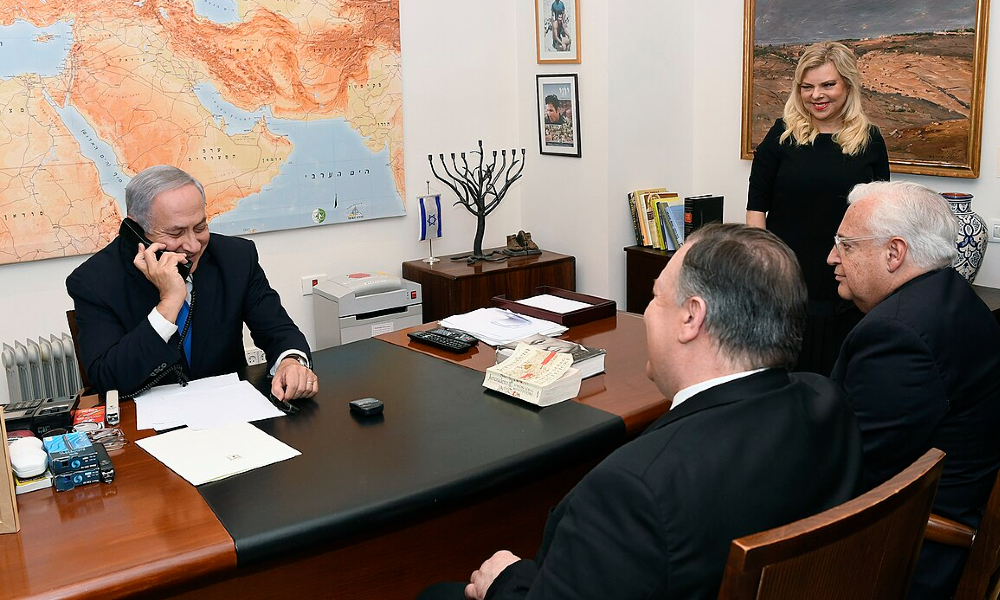
The fear that Netanyahu would follow political motivations rather than national interests is justified, but the source of Netanyahu’s condition is often misunderstood. There is a common belief that Netanyahu is motivated first and foremost by a desire to stay out of prison—that in securing his political future he has secured his freedom, leading him to prefer his own interests to national ones, with dangerous and, in recent years, calamitous consequences. Netanyahu has certainly been intent on avoiding prison, but he has another paramount objective. Above all else, he wishes to remain prime minister, in the place he has come to view as his home, the place he believes no other person can properly occupy: the “aquarium,” the glass-doored suite at the heart of the prime minister’s office in Jerusalem.
Netanyahu’s trial just took a dramatic turn in his favor, with the judges in his case urging the prosecution to reconsider the charge of bribery as well as one of the three cases against him. Will this now end his singular focus to remain prime minister? Its highly doubtful. Netanyahu could have secured his freedom through a plea bargain, and that was indeed discussed. What Netanyahu could not do was secure a plea bargain that let him remain in elected politics. A plea bargain would have necessitated conviction of a felony, but he could have avoided prison. Moreover, his post is not just a tool in his legal case. Holding office as prime minister has not prevented his trial from continuing, even if it has prolonged it. Another avenue, a pardon from Israeli President Isaac Herzog, would have granted him a free pass to continue in politics. Netanyahu pursued it in late 2025, even enlisting President Trump in his efforts. A pardon may require an admission of guilt, however, with all the political cost that entails. This he would not do. Netanyahu’s overriding imperative is to hold on to the prime ministership. He has come to believe, like many late-term leaders before him, that he is irreplaceable and that the fate of the country depends on him manning the helm. The more tumultuous the world, the higher the stakes and the greater the need, in his mind, for him to cling to power.
Between April 2019 and November 2022 Israel held five national elections. The results produced “draws” where no one could form a new governing coalition, a short-lived “national unity” government of Benjamin Netanyahu and Benny Gantz, and a short-lived “change government” led by Naftali Bennett and Yair Lapid.
Netanyahu’s joint government with Gantz meant “rotating” the top spot to the latter after 18 months. The agreement, Gantz’s people believed, was ironclad, secured by a new legal vehicle by which Gantz was “alternate prime minister” and, in fact, pre-sworn-in as prime minister for the designated time. Only one loophole remained: If a Knesset fails to pass a budget by the legal deadline, it is automatically dissolved. Netanyahu, as prime minister, prevented the passage of his own budget to avoid handing over the baton. He left Israel without a budget for all of 2020 and part of 2021 to prevent anyone else from becoming prime minister.
Netanyahu’s supporters claim that during Israel’s long political crisis Netanyahu has “had no choice” but to resort to these tactics, or to cooperate with extremists such as Itamar Ben-Gvir, leader of a party he once shunned. In truth, Netanyahu could have handed over the reins to a chosen successor of his own party, who would have formed a government relatively easily, while agreeing to a plea bargain or receiving a pardon. As simple as stepping aside would have been and clearly rooted in Israeli political precedent, it was never a possibility for Netanyahu. It contradicted the prime directive: Bibi himself, not any set of policies, must govern from the aquarium.
The Two-Year Window
Netanyahu’s belief in his irreplaceability has only grown in recent years. He has spoken explicitly about a two-year window now facing Israel to secure Israel’s interests as he sees them while Donald Trump is president of the United States. He argues that the next president may be very hostile to Israel—though he implies this is due solely to domestic changes in the United States, not to anything he has done. “America has changed,” he said.
With this two-year window in mind, Netanyahu’s sense of unique value has only heightened. He believes that only he can manage the Trump relationship, which will be the crucial test of the next two years. This belief, too, ignores any agency Netanyahu has had in the collapse of Israel’s standing in the United States. (Pew reports 60 percent of Americans hold an unfavorable view of Israel, up from 42 percent in 2022.) It elides the fact that his continued presence in the prime minister’s office would be ruinous for any repair of Israel’s relations with Americans in the broader public or the political class—those other than Trump. Netanyahu’s retention of power is a promise of an all-out dash to pursue his strategic goals. And then, the deluge.
Netanyahu’s strategic goals center on the same foe he and much of Israel have feared for decades: the Islamic Republic of Iran.
He views the years and devastating wars since Oct. 7, 2023, as one war with many fronts, and with reason. He, and most Israelis, see Iran’s hand, to varying degrees, behind all the fronts: Hamas, Hezbollah, the Houthis, militias in Iraq and previously in Syria, and of course Iran itself. Netanyahu, once a cautious leader, has cast this not just as a multifront struggle but as a Churchillian project to defeat the enemy behind it all. Victory in this grand campaign, for Netanyahu, entails reaching its core in Tehran. Regime change in Iran is for him the logical conclusion and end to all the destruction of the past three years.
A Repudiation, Not a Tsunami
The 2026 elections produced a clear popular repudiation of Netanyahu, with 67 new Knesset members opposing him and 53 supporting. However, given the fractious nature of Israel’s political system, there is no easy path to an alternative government. The Israeli president tasked Eisenkot with trying to form a coalition to replace Netanyahu, but there is no guarantee he will succeed. Even another national unity government that includes both men is possible.
While none of the options promises a radical change in Israel’s strategic goals, it would be a grave mistake to think that means there is little difference between them. In the most recent elections, Arab citizens of Israel voted in historic numbers. They did so because they, at least, saw a difference worth voting on. Shortly after the elections, Netanyahu proved them right, when his party claimed a major foreign intervention to buy Arab-Israeli votes had occurred, swaying the results of the election—a claim for which there appears to be no significant evidence. For those who believe (or at least argue) the fate of the country depends on their victory, democratic processes are a small price to pay.
The current fork in Israel’s political road is significant partly for this simple difference. The policy divergences between Netanyahu and Eisenkot are more significant than many claim, including Trump, but there are areas of agreement between them. Even if Eisenkot becomes prime minister, Israel will not become a dove on Iran, or change its stance that the Lebanese government, not Hezbollah, must control its sovereign territory, or that Hamas must disarm in Gaza. But while Eisenkot is no dove, he is far more attuned than late-term Netanyahu to the limits of the use of force. For example, Eisenkot has already said he does not see an immediate threat from Iran requiring a strike now.
More fundamentally, Eisenkot would not be suspected by his own men of using force for the sake of politics. A different leader than Netanyahu, one who does not see the office as his private property, and has not held it for over 19 cumulative years and counting, would be a major improvement.
Netanyahu and his supporters believe he is serving the greater good, not his own parochial interests, of course. The problem is he no longer knows the difference. Leadership without humility about one’s own indispensability can be disastrous. The graveyards are famously full of indispensable men. It is often they who must be replaced most urgently.