Scaling Sovereign Wealth: Evaluating Mechanisms for the U.S. Government to Own Parts of AI Companies
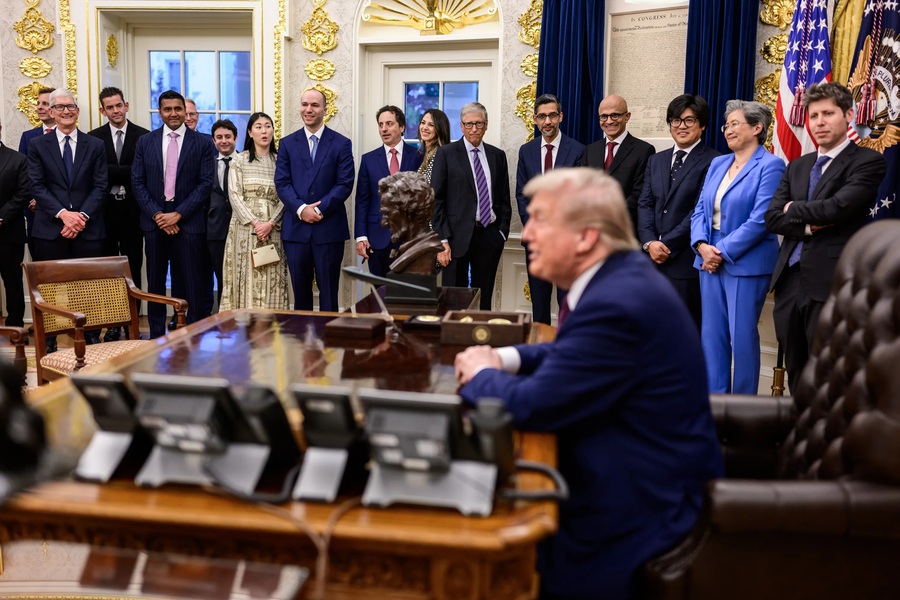

Washington has decided that it wants to own a piece of artificial intelligence (AI). Last summer, Sen. Bernie Sanders (I-Vt.) introduced the American A.I. Sovereign Wealth Fund Act. This bill would claim 50 percent of every “systemically important” company in the AI stack, from AI developers to semiconductor manufacturers, with the goal of distributing annual payments to every American. A few weeks later, according to reporting from the Financial Times, OpenAI CEO Sam Altman met with Trump administration officials and proposed giving the U.S. federal government a 5 percent stake in the company. Under the arrangement, every leading AI company would contribute a similarly sized equity stake to a sovereign fund managed by the federal government. Anthropic’s June 2026 Economic Policy Framework suggests funding capital accounts for every American with equity in AI companies, and the company recently committed 5 percent of its shares to “the public benefit.” Elon Musk has said that he will give one share of SpaceX, producer of the Grok AI model, “to every kid in America.” Meanwhile, the Trump administration has moved to solidify the AI supply chain by deploying funding from the CHIPS and Science Act to open ownership positions in 20 companies. Among these deals is a 10 percent stake in chipmaker Intel, which had struggled for years as sales dropped and debts mounted.
These developments have produced a remarkable convergence of unusual bedfellows. President Trump, America’s most prominent democratic socialist, and leading AI companies have seemingly coalesced around public ownership of a piece of frontier AI. They are primarily pursuing two policy objectives.
First, they aim to fund direct payments to American households. These payments, reminiscent of universal basic income proposals, could help Americans adapt to rapid economic changes that result from AI. Anthropic’s Economic Policy Framework suggests “universal basic income, AI sovereign wealth funds funded by investment stakes in AI-driven productivity, [and] equity-sharing mechanisms” to address scenarios where AI causes unemployment to soar beyond historical peaks. An industrial policy paper published by OpenAI proposes a “Public Wealth Fund” that is invested in AI firms and provides every American “a stake in AI-driven economic growth.” Google DeepMind chairman Demis Hassabis has expressed support for “universal high income” proposals that redistribute new resources realized by AI. Trump has alluded to an equity ownership arrangement “where pieces could be given to the American public, where the American public essentially becomes a partner …[.] It would make ‘em rich.”
Second, some advocates are interested in using public ownership to control the AI sector from inside the boardroom. Sanders has called for companies to pause AI development, and a summary of Sanders’s bill released by his office suggests that the government could “use voting shares in companies to block decisions that hurt the American people and push for policies that help them.” Meanwhile, the Trump administration views AI as a technology critical to national security and has taken steps to bring AI under the supervision of intelligence agencies. Equity in AI firms could grant the White House information rights regarding internal activities at AI firms.
These two objectives are best served by different kinds of ownership arrangements. A revenue-sharing arrangement is most suitable for distribution of direct payments, and a golden share is most appropriate for oversight of the AI industry. These two mechanisms can be used separately or together, but neither entails the government owning equity in AI companies. Voting common stock, another potential financial instrument, is poorly suited to both policy objectives, as the mechanism interferes with industry regulation, encounters legal obstacles, and puts the federal budget at risk. The ambiguous policy discourse so far has allowed Trump, Sanders, and Altman to equivocate on specifics. Each leader has been able to slip between different financial instruments under the more general guise of government stakes.
Note that the traditional tools of taxation and regulation remain available, even absent any ownership scheme. The U.S. government does not need equity to regulate corporate conduct, nor does it need stock to raise revenues. Ideas abound for ways Congress can levy new taxes on AI firms or place safeguards on AI development. But with both the populist left and the populist right calling for stakes in AI firms, the policy discourse may have left taxation behind. A relevant question, then, is which instruments the government should aspire to hold to pursue its desired goals.
Three Problems With Voting Common Stock
When most Americans hear that the government is considering holding equity in AI firms, they will likely assume that the agreement delivers common stock with voting rights to the government. These shares resemble the bulk of equity that the American public trades on the New York Stock Exchange and Nasdaq. Under this arrangement, the government would be able to vote on significant company decisions, with its voting power proportional to the number of shares that it holds. However, this scheme encounters two issues that prevent voting common stock from being a strong oversight mechanism.
First, the political and regulatory costs of exercising shareholder control are high. Conflicts of interest and poor optics make voting common stock a challenging mechanism for industry oversight. Whenever the U.S. government has held voting stock in the past, it has made a point of not using its newfound powers for precisely this reason. When the Obama administration emerged from the Great Recession holding 61 percent of General Motors and 92 percent of AIG, the Treasury Department published principles that it would manage its ownership stake in a “hands-off, commercial manner,” noting that “the government will not interfere with or exert control over day-to-day company operations.” The government claimed that it had “no desire to own equity stakes in companies any longer than necessary” and, indeed, had completely offloaded its shares in both companies by 2013. The government’s 10 percent stake in Intel, acquired last year, has continued this precedent. The Trump administration committed to voting with the board on most matters, essentially relegating the government to passive, nonvoting status. The government has no board representation, nor any special governance or information rights, tied to its Intel stake.
Administrations of both parties have opted to keep the day-to-day operations of these companies at arm’s length, regardless of the size of the government’s stake, as failing to do so comes with political and regulatory costs. When AIG paid bonuses to its employees, the ensuing public backlash consumed the Obama administration for weeks and drove the House to pass a 90 percent tax on the payments. A government that operates a company also inevitably encounters conflicts of interest as a regulator. This reality is particularly true of AI, a growing sector that threatens to disrupt the job market, consume vast amounts of energy, and even, if AI executives’ claims are to be believed, wipe out humanity. The federal government is already the industry’s chip export regulator through the Bureau of Industry and Security, standards-setter through the National Institute of Standards and Technology, and security reviewer through an array of intelligence agencies. Both OpenAI and Anthropic have had AI models delayed by government scrutiny, and the Pentagon has even designated the latter a “supply chain risk.” The day may come when the federal government must more actively enforce antitrust laws or consumer protection laws on this still-nascent industry. But if the government plays an active role in these companies’ daily functions, each of these critical regulatory decisions will be clouded by an appearance of a conflict of interest, regardless of whether a conflict truly exists.
Second, even if the government did break precedent and exercise corporate control, existing law may undermine those efforts. Even a small stake in AI companies could allow the government to appoint a proportional number of members to the board of directors. However, both OpenAI and Anthropic are incorporated in Delaware, and Delaware fiduciary doctrine requires board members to consider their stockholders’ pecuniary interests. In eBay Domestic Holdings v. Craig Newmark, the Delaware Court of Chancery held that board members must aim to maximize stockholder value, and all corporate decisions must ultimately be a means to that end: “promoting, protecting, or pursuing non-stockholder considerations must lead at some point to value for stockholders.” A government-appointed board member or government controlling shareholder that uses its stake in an AI firm to pursue policy objectives unrelated to stockholder value, such as mitigating environmental impact or advancing worker welfare, could be in violation of this obligation. In re Trados Incorporated Shareholder Litigation, the Delaware court determined that board members must pursue the interests of common stockholders and the company, rather than prioritizing the interests of preferred stockholders who may have appointed the board members. In 1971, Sinclair Oil v. Levien established the controlling-stockholder doctrine. According to this doctrine, a majority stockholder who obtains benefits that the minority does not share—a slower data center buildout in constituents’ favor, for instance—faces the “entire fairness” standard, which requires board members to demonstrate that a transaction is fair to the company and minority investors. This standard is the strictest review applied in corporate law.
Anthropic and OpenAI are both public benefit corporations (PBCs)—for-profit companies that aim to advance a certain public benefit, such as positive economic, scientific, or technological effects. A PBC’s board must balance its stockholders’ pecuniary interests with the company’s public benefit goals, as well as the interests of others affected by the company’s conduct. How these legal precedents apply to PBCs remains unclear. Striking a balance is not necessarily straightforward, and a government director who guides corporate decisions based on political objectives could face litigation from minority shareholders. These minority shareholders could include company employees, venture capital firms, and other investors.
The drafters of Sanders’s bill understood this legal backdrop, and his legislation affirms that policy goals such as worker welfare and environmental sustainability “shall be a proper purpose consistent with the fiduciary and other duties” of the government’s board representatives. Notably, his bill includes text confirming that board representatives can pursue these goals “even where doing so conflicts with the financial interests of the company or its other equity holders.” If the federal government is to hold a significant enough stake in AI companies to meaningfully control them, then Congress will have to undermine a pillar of Delaware corporate law to pass a provision such as this one.
Finally, voting common stock is ill-suited for distributing direct payments to the American public. The Sanders bill would make yearly payments to the public, with its annual total payout equal to 5 percent of the market value of the government’s equity. However, major AI companies currently remain unprofitable and are reinvesting almost all of their earnings into compute, personnel, and other costly expenditures. The bill also prevents the shares from being sold. To start, then, Sanders’s proposal may have to leverage the government’s shares to draw from the U.S. Treasury, rather than pull from OpenAI or Anthropic’s revenues. This approach would risk increasing the federal deficit or reducing available funding for other important federal programs.
For all these reasons, the path to regulatory oversight or direct payments through voting common stock is no simple task.
Want to Distribute Payments to Americans? A Revenue-Sharing Agreement Is the Better Answer
In another intriguing convergence, both Altman and Sanders have cited the Alaska Permanent Fund (APF) as their model for a sovereign wealth fund that distributes payments to American households. Established in 1976, the APF is funded by revenues that the state of Alaska collects from allowing oil companies to drill on state-owned land. The fund typically distributes between $1,000 and $2,000 to every Alaskan resident annually.
Sanders and Altman’s reference point is curious, however, as Alaska owns no equity in ExxonMobil, ConocoPhillips, or other oil companies. The state does not have a seat in the boardroom, and the APF does not tell companies where to drill or how to structure their corporate activities. Instead, the Alaska state government has effectively established a revenue-sharing agreement, whereby companies pay royalties to the state. These royalties are then deposited into the fund, which invests in a diversified portfolio and pays Alaskans every year. Instead, regulation is left to state agencies that specialize in environmental protection, resource management, and workplace safety. The APF may owe its 50 years of longevity to this fact, as the public’s claim on natural resources always remained separate from regulation. Debates about the fund never became a fight over the state’s role in the oil business.
Just as Sanders and Altman claim, the APF can serve as a model for the AI industry. As discussed previously, Sanders’s current proposal is backed by a fluid valuation of AI companies’ stock and could draw down the U.S. Treasury. A revenue share presents a superior policy option, as the AI labs currently bring in significant revenue, even if they are unprofitable. While AI companies would retain and reinvest most of their revenues, a preagreed fraction of their earnings would be transmitted to the government, which in turn would make direct payments to Americans. A revenue-sharing agreement accomplishes redistribution while avoiding valuation risk and awkward political entanglements. Revenue sharing is also conceptually simpler and negates the need to subjectively assess the market value of the government’s shares.
Skeptics may argue that a tax on AI company profits is a superior instrument. However, a revenue-sharing agreement powerfully frames the payments as rent that the American public collects on a shared resource, since much of AI’s utility is derived from scraping the web. By contrast, a tax frames the payments as a share of someone else’s income. A revenue-sharing agreement does not concede proper oversight of the AI industry. U.S. federal agencies will continue to be empowered to regulate AI development. They should still vigorously protect public lands, consumers, and national security using tools such as rulemaking, standards-setting, and nonbinding guidance. But under this framework, they could do so unencumbered by conflicts of interest and the challenging optics of a government appointee sitting in company boardrooms.
Want to Regulate AI Development? A Golden Share Is the Better Answer
If the objective of an ownership scheme is instead oversight, then a golden share is a superior instrument to voting common stock or a revenue-sharing agreement. A golden share is a single share that does not include equity but instead grants the shareholder control or veto power over certain corporate actions. Unlike with common stock, the authorities conveyed by a golden share are not proportional and generally cannot be transferred or sold. The government currently holds a golden share in U.S. Steel, obtained as a condition for allowing Japanese Nippon Steel to acquire the American firm in 2025. The contract, which is the first of its kind in the U.S., permits the U.S. president to block major corporate decisions, including offshoring jobs, closing plants, or relocating from Pittsburgh. President Trump reportedly used this authority to prevent the closure of U.S. Steel’s facilities in Granite City, Illinois, which would have put 800 employees out of work. This type of federal intervention, made possible by a golden share’s unique structuring, is a departure from the government’s reluctance to meddle with corporate decisions when it holds voting common stock.
Research has found that a golden share can serve as a powerful substitute for traditional regulation. As Europe privatized many industries throughout the 1980s and 1990s, governments frequently opted to keep a golden share in utilities, telecommunications providers, and military contractors to protect state interests. The U.K. government, for instance, retained golden shares in Rolls-Royce, British Aerospace, British Telecom, Cable and Wireless, British Steel, and Jaguar. The French government owned a golden share in oil company Elf Aquitaine. Many of these firms had been nationalized in the decades following World War II to support postwar rebuilds and boost employment, or to rescue struggling industries. When European governments moved away from golden shares at the turn of the 21st century, they were willing to do so only after applying new industry regulations. France abandoned its golden share in Elf Aquitaine only after merging the company with other French firms (now TotalEnergies, the world’s seventh largest oil company by revenue), establishing an energy titan that could resist a potential foreign takeover. The U.K. government was willing to relinquish its golden share in the British Airport Authority, then-owner of Heathrow Airport, but only after enacting regulations to cap passenger fees and limit runway expansions. Hence, a golden share can often be interchangeable with traditional regulation.
If the U.S. government holds a golden share in AI companies, it may be able to ensure safe AI development, prevent harms to consumers, or pursue other public interests that might otherwise require regulatory measures. The government could veto the rollout of misaligned models to buy more time for defensive measures, for instance. It could also block AI model releases that threaten mass unemployment or prevent reckless training practices that lead to risky outcomes, like the OpenAI-Hugging Face incident. It could pump the brakes on competitive pressures faced by AI companies and order a slowdown across the frontier. A golden share could be time-bound, thus allowing a period for enacting traditional regulatory measures, or exist in perpetuity. The open-ended and flexible character of a golden share makes it a capable tool for governing the uncharted risks presented by AI. Importantly, a golden share avoids the legal uncertainties presented by Delaware fiduciary law. And as the U.S. Steel example illustrates, the government may feel more emboldened to intervene in corporate affairs if it owns a golden share rather than voting common stock.
With that said, a golden share is not without its limitations and risks. A golden share only empowers the government to steer decision-making on areas that can be identified today. With the AI industry evolving rapidly, it may be challenging for contract drafters to foresee powers that the government will need further down the line. Golden shares in AI companies may also face legal challenges. The government’s agreement with U.S. Steel has stood on firm legal footing thus far because it is rooted in Section 721 of the Defense Production Act (DPA), which enables the government to impose conditions on foreign acquisitions of U.S. firms that threaten national security. This national security provision powerfully shields the U.S. Steel golden share from judicial review. Without a foreign acquisition to trigger DPA review, the government’s pursuit of golden shares in AI would rest on new contracts or new legislation designed from scratch. These novel arrangements could invite all kinds of litigation. Plaintiffs could argue that the golden share violates AI companies’ First Amendment rights, for instance, or that the firms were coerced into reaching an agreement with the government.
Additionally, it is unclear what the federal government could offer to AI companies in return for a golden share. The U.S. Steel golden share materialized only because the government had serious leverage in evaluating Nippon Steel’s proposed takeover. Although currently well-funded by private capital, the AI sector does have other desires that the federal government could fulfill: federal contracts, a liability shield, a loosening of export controls, or land and power for data centers.
Washington Should Deploy a Revenue-Sharing Agreement and a Golden Share in Combination
Despite its potential upsides, the development of advanced AI threatens to cause extraordinary economic disruption and adverse social impacts. Americans are cognizant of these dangers. Polling from July 2026 reveals that just 9 percent of Americans believe AI does more good than harm. Americans are anxious about the impacts of AI on their jobs, electricity bills, and quality of life. Proposals for the U.S. government to own parts of AI companies represent an opening for Washington to put guardrails on this technology and ensure that AI’s benefits accrue to the American public through direct payments. These payments, which the Social Security Administration or Internal Revenue Service could be well-positioned to execute, may provide flexibility for Americans to adapt to job displacement that results from AI diffusion.
However, as this article has illustrated, voting common stock falls short of these policy objectives, as it runs into high political and regulatory costs, as well as uncertain legal terrain. Leveraging voting common stock of unprofitable companies to fund direct payments to Americans fails to extract corporate revenues and may draw down the U.S. Treasury. Instead of pursuing voting common stock, the federal government should consider deploying a revenue-sharing agreement and golden share in combination. A revenue share funds direct payments without interfering with the regulatory process. A golden share is a compelling tool for controlling corporate behavior. Used in tandem, these two instruments may be the ownership mechanism the U.S. needs to mitigate social harms and ensure that Americans remain stewards of their economic future in the AI age.